Hand Drawn Education Related Objects: Bringing Authenticity to Learning Design
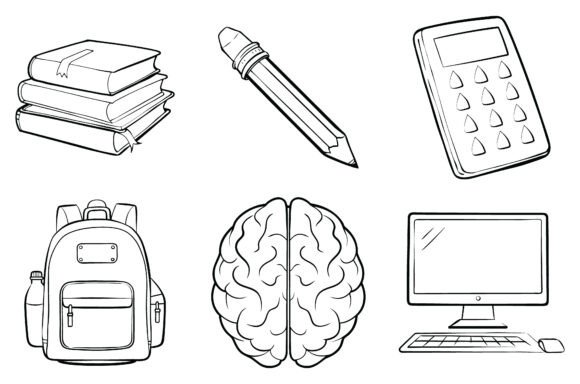
In a digital landscape often dominated by sterile, perfectly rendered 3D icons and glossy stock photography, there is a distinct charm in the imperfect. Hand drawn education related objects offer a tactile warmth that standard vector graphics simply cannot replicate. Imagine a detailed black and white outlined illustration showcasing essential school supplies—books stacked slightly askew, a pencil with a worn eraser, a calculator with visible buttons, and a stylized brain representing cognitive growth. This isn't just a collection of clip art; it is a visual language that speaks directly to the human experience of learning.
This monochrome style, characterized by clean lines and a modern aesthetic, serves as a versatile foundation for creators who want to communicate knowledge without the distraction of heavy color palettes. Whether you are designing resources for a university course or a playful back-to-school campaign, this approach bridges the gap between academic rigor and creative expression.
The Power of Monochrome in Educational Storytelling
Why choose a black and white outline when color is so prevalent? The answer lies in focus. When you strip away the hues, you force the viewer to engage with the form and the concept. A detailed illustration featuring a brain alongside a calculator immediately signals a connection between creativity and logic. Without color to compete for attention, the relationship between these elements becomes the star of the show.
This specific aesthetic is incredibly adaptable. Because the design relies on outlines rather than solid fills, it can be easily manipulated to fit any brand identity. You can keep it stark black on white for high-contrast readability in printed handouts, or apply a single accent color later to match a specific institution's branding. It removes the friction of finding "perfect" colors that clash with existing materials, allowing designers to prioritize content over decoration.
Real-World Applications Across Industries
The utility of hand drawn education related objects extends far beyond the classroom walls. While the imagery might scream "school supplies," the underlying message is about the process of acquiring knowledge, which is relevant to adults and professionals just as much as students.
Back-to-School Promotions and Marketing
For educational institutions and retailers, the beginning of an academic year is a critical marketing window. Traditional ads often feel generic. However, using a hand-drawn style for a brochure or social media banner creates an immediate sense of nostalgia and authenticity. It suggests that the learning environment is personal and welcoming. A flyer advertising a new tutoring service featuring a sketch of a brain and books feels less like a corporate pitch and more like a recommendation from a mentor.
Student Resources and Study Guides
Consider the student creating their own study notes. Digital apps are efficient, but they can feel cold. Incorporating hand-drawn icons into digital flashcards or printable worksheets makes the material feel more approachable. When a learner sees a sketch of a pencil next to a complex math problem, it lowers the psychological barrier to entry. It implies that mistakes are part of the drawing process, encouraging a growth mindset where errors are viewed as steps toward mastery rather than failures.
Technology Tutorials and STEM Content
There is a unique synergy between the organic nature of hand-drawn art and the structured world of science and technology. Using these illustrations in tutorials for coding, engineering, or data analysis provides a visual break from dense text and code snippets. A diagram explaining the basics of algebra or computer logic benefits from the inclusion of a calculator and a book icon. It grounds abstract concepts in physical reality, making them easier to grasp for visual learners who need to see the tools of the trade represented in a familiar way.
Who Benefits Most from This Visual Style?
Different users find value in this aesthetic for varying reasons. For graphic designers, the primary benefit is flexibility. The clean lines of a vector graphic allow for easy scaling, meaning the same image can look crisp on a business card or massive on a billboard. There is no loss of quality, and the file size remains manageable, which is crucial for web performance.
Educators and instructional designers appreciate the clarity. In an era of information overload, simplicity is a superpower. A slide deck that uses these outlined objects to categorize topics (e.g., one section for Math, one for Science) helps students navigate the curriculum without visual fatigue. The lack of color prevents the slides from looking cluttered, ensuring that the instructor's voice remains the focal point.
Content creators in the EdTech space also find this style invaluable. Apps and online courses often struggle to convey personality. By integrating hand-drawn elements, developers can inject a sense of playfulness and humanity into software that might otherwise feel robotic. It transforms a dry interface into an inviting workspace.
Practical Considerations Before Implementation
While the appeal of hand drawn education related objects is strong, there are practical factors to consider before integrating them into your projects. The first is consistency. Hand-drawn styles can vary wildly depending on the artist. One illustrator might create thick, bold lines that feel robust, while another might use delicate, fine strokes that appear fragile. When building a cohesive design system, ensure that all icons share the same line weight, stroke style, and level of detail. Mixing a highly detailed brain with a minimalist pencil can disrupt the visual harmony of your layout.
Another consideration is accessibility. Black and white designs are generally excellent for accessibility, but contrast ratios must still be checked. If you plan to place these outlines on colored backgrounds, ensure the black lines remain distinct against the backdrop. Furthermore, while these images are great for decoration, they should not replace descriptive alt text for screen readers. Describing the scene—"an outline illustration of a brain, books, and a calculator"—ensures that everyone, regardless of ability, understands the context of the image.
There is also the question of scalability in print versus digital. While vector graphics scale infinitely, the perceived "hand-drawn" effect can sometimes get lost if the image is too small. Ensure that the details, such as the texture of a book cover or the buttons on a calculator, remain legible at the intended display size. If the design is destined for a thumbnail view, simplifying the details might be necessary to maintain clarity.
Strengths and Limitations of the Outline Approach
The greatest strength of this style is its neutrality. It does not impose a specific mood through color psychology, allowing the content to define the tone. It works equally well for a serious medical textbook or a whimsical children's storybook. This versatility makes it a safe bet for organizations with diverse audiences or those needing to produce materials for multiple demographics simultaneously.
However, there are limitations. If your goal is to evoke excitement, energy, or urgency, a monochrome palette might fall flat compared to vibrant, full-color imagery. In high-stakes environments where immediate emotional engagement is required, such as emergency training manuals or high-energy sports promotions, the subtle elegance of an outline might be too understated. Additionally, while the style is modern, it can sometimes lean towards retro if not balanced correctly. Careful selection of the line work is essential to ensure the final product feels contemporary and not dated.
Moving Forward with Creative Confidence
Ultimately, the decision to use hand drawn education related objects is a decision to embrace authenticity. In a world of automation, the slight imperfection of a hand-drawn line reminds us that learning is a human endeavor. It connects the past traditions of schooling with the future possibilities of digital innovation.
Whether you are a teacher preparing a lesson plan, a marketer launching a new course, or a developer building an educational app, these illustrations provide a bridge. They turn abstract ideas into tangible visuals, making the journey of learning feel accessible, enjoyable, and deeply human. By leveraging the clean, modern aesthetic of these outlined designs, you can create materials that not only inform but also inspire.